Thirty degrees. A queue that won't quit. A chiller working harder than you are. Brilliant for takings, brutal for food safety. Here's the thing about a heatwave: the law doesn't bend for it. The temperatures your food has to hit stay exactly the same whether it's drizzling in March or baking in August. Let's make sure your setup copes.
The number that matters is 8
Chilled food has to be kept at 8°C or below. That's the legal maximum in England and Wales (Northern Ireland has the same rule), written into food hygiene law. It applies in the fridge and on the display counter alike. The full detail sits in the official temperature control guidance if you fancy the long version.
Worth knowing why the number exists. Between 8°C and 63°C is the danger zone where bacteria multiply fastest. Your job in a heatwave is moving food through that zone quickly, or keeping it out entirely. And 8 is the ceiling, not the target. Aim for 5. On a hot day a fridge that normally sits at 5 will creep. The gap between 5 and 8 is your safety margin. Watch it disappear by mid-afternoon.
The 4-hour rule (and its catch)
There's flexibility built into the law for display. Chilled food can come out of temperature control for a single period of up to 4 hours. After that it's use it or bin it. Not back in the fridge for tomorrow. Bin it.
The catch is the word "single". You get one 4-hour window per item, ever. Which means you need to know when each tray came out. On a scorching Saturday, nobody remembers. Write the out-time on a bit of tape stuck to the tray. Thirty seconds of faff, and suddenly the rule is enforceable at your own counter.
Hot food runs the same way in the other direction. Hot holding means 63°C or above, with a single 2-hour window below that before the food's done. If your hot cabinet struggles when the van's cooking in the sun, that 2-hour clock matters.
Getting your van through a scorcher
- Don't overload the chiller: warm air needs to circulate. A rammed fridge on a 30-degree day is a slow fridge. Cool boxes with ice packs take the overflow.
- Prep in the cool hours: whatever can be portioned, sauced or sliced before 10am should be. Every minute the fridge door stays shut in the afternoon is a win.
- Shade the display: direct sun through a display cabinet adds degrees you can't afford. Move it, shade it, or shrink what's on show.
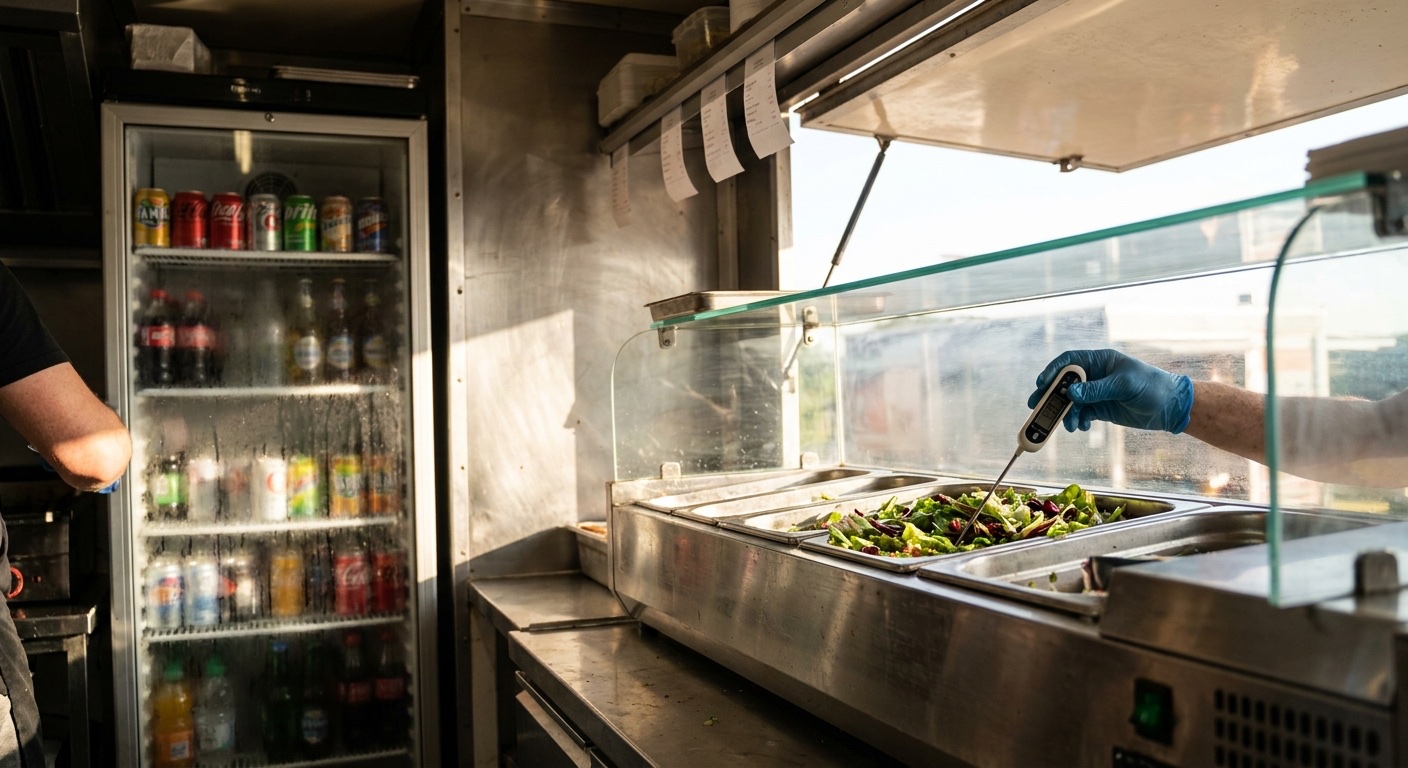
- Probe and log: check fridge temps morning, midday and mid-afternoon. Takes a minute. If something's drifting you find out at 1pm, not when the ice cream's soup.
- Small batches out front: keep the bulk in the coldest spot and top up the display little and often. Less in the danger zone at any one time.
💡 Pro Tip
A £15 probe thermometer and a biro turn "I think the fridge is fine" into a written record. If an environmental health officer visits during a heatwave (they do, it's their busy season too), a temperature log from that morning is the best first impression you can make.
And what about you?
Odd fact: there's no legal maximum working temperature in the UK. None. The HSE's own guidance says workplace temperature must simply be "reasonable", which is cold comfort when you're flipping burgers next to a fryer in a metal box.
Your fridge has more legal protection from heat than you do. So build your own rules. Water within reach at all times, not back in the cab. Swap whoever's on the griddle every hour. Prop the service hatch and the back door for a through-breeze. And if you're feeling dizzy or sick, that's heat exhaustion talking, not weakness. Step out. The queue will cope.
Where hot days go wrong
- The mayo in the sun: squeezy bottles living on the counter all day. Condiments count as food too.
- The restock run: chilled stock sat in a hot car boot from the cash and carry. Bring cool boxes or buy closer to service.
- Generator strain: fridges pulling hard in the heat can trip an overloaded generator. Know your amps before the weekend, not during it.
- The "it was only out an hour" guess: without the tape-and-time trick, an hour was probably three.
If you're wondering where all this sits officially, the FSA's Safer Food, Better Business pack has the chilling and hot-holding methods laid out. It's what your EHO marks you against.
Two free downloads for hot weeks
Our Cleaning Schedule Template keeps the wipe-downs on track when you're slammed. The Food Safety Risk Assessment is where your heatwave plan should live in writing.
Browse All TemplatesHeatwaves are good business. People are out and hungry. Cold drinks sell themselves. The vendors who do well in a scorcher are the ones whose fridges behave and whose staff make it to Sunday evening intact. Tape on the trays, probe in the pocket, water in reach. Sorted.